Two-Stage RecommenderRetrieval Then Ranking
A production-shaped recommender: matrix-factorization candidate retrieval feeding a LightGBM ranker, evaluated leave-last-out on Recall@k, NDCG@k and MAP@k against a popularity baseline.
Headline results
- SVD retrieval
- Recall@10 0.1405
- Popularity baseline
- 0.0745
- Lift
- ≈1.9×
- Two-stage
- 0.1065, below retrieval alone
System architecture
Problem
Real recommenders are two-stage because scoring millions of items with a heavy model is impossible: retrieval narrows to a few hundred cheaply, ranking spends the expensive model only on those. Most portfolio recommenders stop at cosine similarity top-k, which skips both the architecture and the question of what each stage contributes.
Approach
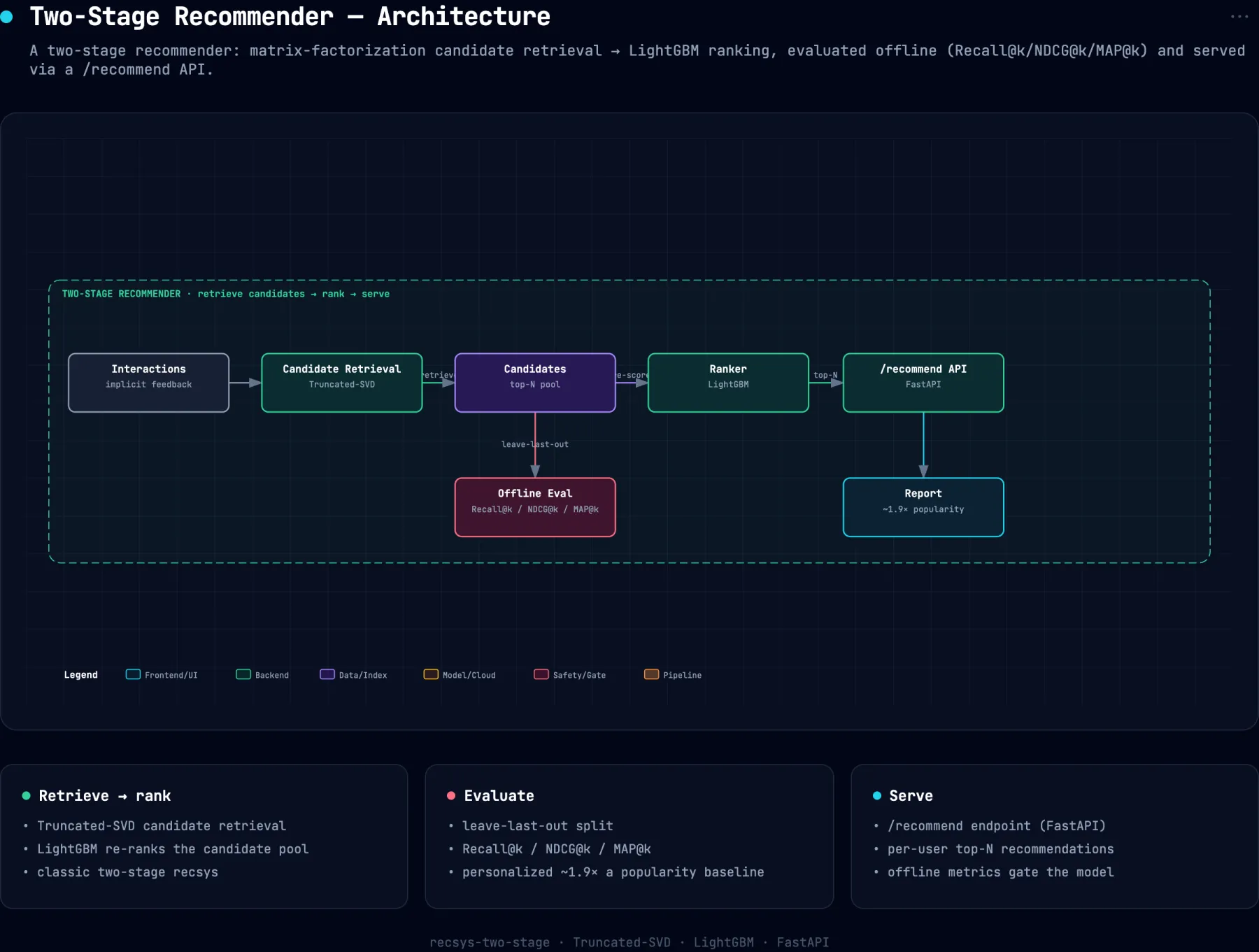
Stage one retrieves with truncated-SVD user and item embeddings, scoring all items and keeping the top N. Stage two re-ranks those candidates with a LightGBM classifier over richer features: the SVD score, item popularity, category affinity, user activity, and item quality. Evaluation is leave-last-out, holding out each user's most recent interaction so nothing leaks into training, scored on Recall@k, NDCG@k and MAP@k against a popularity baseline so each stage's contribution is explicit.
Impact
Both personalized systems beat the popularity baseline decisively, with SVD retrieval reaching Recall@10 of 0.1405 against 0.0745, roughly 1.9×. The honest complication is that the LightGBM ranker scores below retrieval alone at 0.1065, so on this synthetic data the second stage cost recall rather than adding precision. That is reported rather than tuned away, because a ranker that does not beat its own candidate generator is the normal first result and the reason ranking features get iterated on.
Decisions & tradeoffs
Report the stage that did not help
The LightGBM ranker scores below SVD retrieval alone on this data. Publishing that is more useful than tuning until the architecture looks right, because it identifies the ranking features as the thing to work on.
Hold out the most recent interaction, not a random one
Random held-out positives let a model use a user's later behaviour to predict their earlier behaviour. Leave-last-out matches how the system would actually be used.
Keep retrieval cheap on purpose
SVD embeddings score every item in the catalogue quickly, which is the whole reason the first stage exists. Anything heavier there defeats the two-stage architecture regardless of how good the ranker is.
Build spec
- Evaluation
- Leave-last-out, 2,000 test users, k = 10
- popularity
- Recall 0.0745 · NDCG 0.0375 · MAP 0.0264
- svd retrieval
- Recall 0.1405 · NDCG 0.0690 · ~1.9× baseline
- two_stage
- Recall 0.1065 · NDCG 0.0502
- Stack
- Truncated-SVD → LightGBM ranker → /recommend API
System notes
- Leave-last-out evaluation holds out each user's most recent interaction, so nothing leaks
- Each stage is scored separately against the baseline, which is what makes the second stage's regression visible
- The popularity baseline is not a formality: it is the bar personalization has to clear and often does not
- Recall, NDCG and MAP together, because ranking quality and retrieval coverage are different questions
What this does not show
- The LightGBM ranker scores below SVD retrieval alone on this synthetic data. That regression is reported rather than tuned away.
Stack
Truncated-SVD · LightGBM · Recall@k / NDCG@k / MAP@k · FastAPI