Automated Summary EvaluatorADHD-Aware Learning Aid
An ADHD-aware learning platform that auto-scores student summaries on content and wording, then pairs each grade with LLM feedback and a research-grounded chatbot.
Headline results
- Grades
- Student summaries, instant feedback
- UI
- ADHD-friendly
- Surface
- Dashboard · chatbot · quizzes
- Stack
- React + FastAPI + Pinecone
System architecture
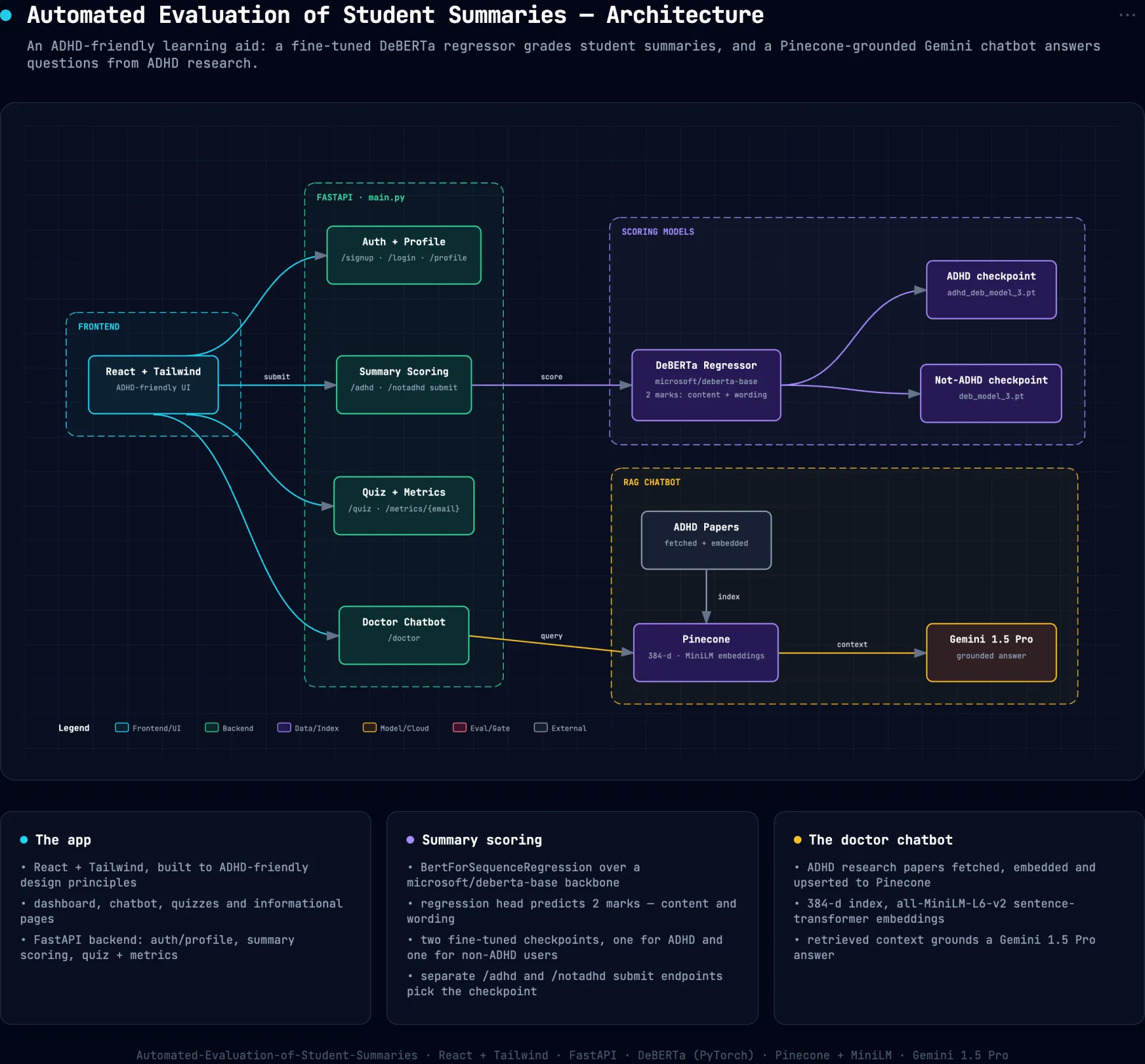
Problem
Grading student summaries for content and wording is manual, slow, and inconsistent, and standard ed-tech UIs ignore the accessibility needs of ADHD learners. Students get scores without actionable, age-appropriate guidance on how to improve.
Approach
A FastAPI backend serves two fine-tuned DeBERTa regression heads, separate ADHD and non-ADHD checkpoints, that predict content and wording scores from a summary and normalize to 0 to 100. Each summary is also sent to Gemini for grade-appropriate grammar and structure feedback. A doctor chatbot does RAG over ADHD literature: it scrapes PubMed, embeds abstracts with MiniLM into a Pinecone serverless index, retrieves top-k, and answers via Gemini. A React and Tailwind frontend with an ADHD-friendly design, auth, quizzes, and Chart.js dashboards consumes the API.
Impact
Each submission gets dual numeric scores plus explanatory, child-friendly feedback, alongside a literature-grounded ADHD Q&A assistant. It combines a custom regression model, a generative LLM, and a RAG pipeline in one accessibility-first learning aid, demonstrating an end-to-end full-stack ML product.
Decisions & tradeoffs
Separate ADHD and non-ADHD scoring models
Two dedicated checkpoints are routed via distinct endpoints rather than one shared model. The cohort distinction is baked into scoring rather than adjusted after the fact, at the cost of maintaining two model files.
DeBERTa regression for scores, Gemini for explanations
A fine-tuned regression model gives stable numeric scores while a generative LLM supplies open-ended, grade-appropriate feedback. Splitting these avoids asking one model to both grade reliably and explain fluently.
Pinecone serverless with live PubMed scraping
The doctor chatbot scrapes and upserts fresh PubMed abstracts per query rather than maintaining a static corpus. Answers stay grounded in current literature, at the cost of scraping fragility and per-query latency.
Build spec
- Scoring model
- microsoft/deberta-base, dual heads
- Feedback LLM
- Google Gemini 1.5 Pro
- RAG
- MiniLM + Pinecone serverless over PubMed
- Backend
- FastAPI + PyTorch + SQLite
- Frontend
- React 19 · Tailwind · Chart.js
System notes
- Two distinct fine-tuned DeBERTa regression checkpoints, separate ADHD and non-ADHD scoring models
- A custom regression head concatenates a content vector with the DeBERTa output for dual content/wording scores
- A RAG doctor chatbot: live PubMed scraping, MiniLM embeddings, Pinecone serverless, Gemini answers
- An ADHD-friendly React and Tailwind frontend with OAuth, Chart.js dashboards, and a chatbot kit
Stack
DeBERTa · PyTorch · Gemini · Pinecone · React · FastAPI